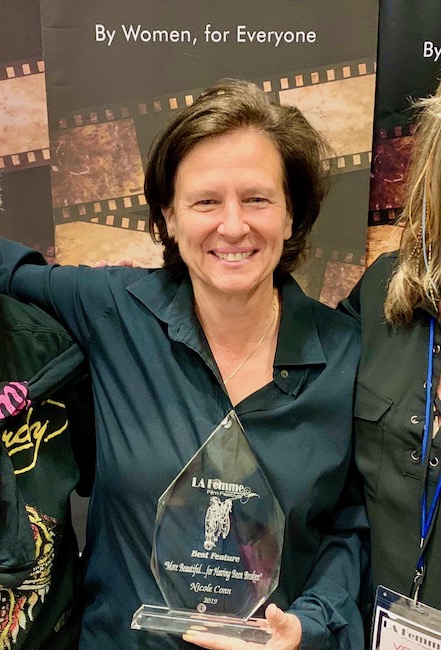
Author Q&A With Nicole Conn
Nicole Conn is best known for her cult classic Claire of the Moon. Other works include Elena Undone, A Perfect Ending, Little Man”(12 Best Documentary Awards), More Beautiful for Having Been Broken, and Coming Out For Love. In the spring of 2026, she will release Blue Love Dance – A CineRomance. It took her 25 years, but in 2025 her sweeping epic romance, Descending Thirds, was finally published. Nicole is now focusing on setting up Descending Thirds as a sweeping limited mini-series with epic/Emmy-winning roles. Meet Nicole:
You are an author, but is it your day job? It is my day job. Along with all the other hats I wear in rotation, writer, director, producer, editor, therapist to actors, mother, fundraiser, marketer. Storytelling has been with me since the third grade, when my stepfather thought I showed so much talent that he became my “agent.” You’re constantly building worlds while simultaneously figuring out how to keep the lights on. My days are usually filled with writing, editing, developing projects, marketing, talking to audiences, and trying to carve out enough stillness to hear the next story knocking. My most important and rewarding job is as a mother and grandmother. I also puzzle, play poker, and pup!
Did you always want to be an author? Literally forever. I was an obsessive and voracious reader and adored my stepfather’s den. Every wall is covered in books. He introduced me to the classics: Dickens, Du Maurier, Tolstoy, and JD Salinger. I would also sneak in while he was at work and read Fire Island, Valley of the Dolls, and Peyton Place. Gone With The Wind stole my heart when I was in the 4th grade. And I even made it through Anna Karenina in the 5th grade, but I much preferred the tortured Heathcliff in Wuthering Heights, and everything Jane Austen wrote. Romance is my calling card.
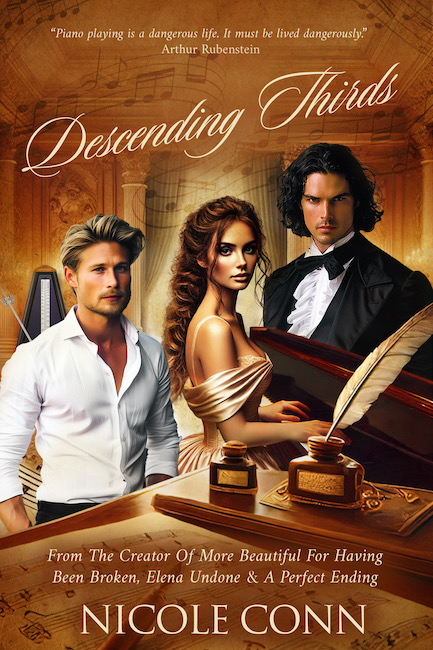
What is your most recent book, and what inspired you to write it?
My newest novel is Descending Thirds, an epic romantic drama set against the backdrop of the often ruthless world of international classical piano, competition, and the struggle to survive in a career. At its center is Alexandra von Triessen, who finds herself caught between two extraordinary brothers – both composers. One, a charming and irresistible lothario and showman, the other quietly certain, a genius savant, a composer who writes purely for the music and couldn’t care less about fame and glory.
The inspiration came from several places colliding: the day after I was born, my father bought my Mother, a classical pianist, a new piano. She tossed me in the crib and began playing, which fostered my lifelong love of classical music. My passion for music is part of my DNA. As a kid, I would lie beneath the piano as she played, absorbing the insanely gorgeous notes vibrating through my body. (which became a scene in the book.)
My Mother, Christa Hoven, is a character in the book as Alexandra’s first piano teacher. Music is sort of an imperative for me. Ask any composer I work with for the scores in my films. I sit on them to create the precise emotional nuance the stories and cast require. Being in the entertainment business is the basis of my fascination with the cost of artistic greatness and the price of fame, both themes in the book. When I was doing research for the book, my Mother and I would devour VHS tapes of the Van Cliburn Competitions, held but once every four years, which inspired the Ketterling Competition that opens the book.
How do you hope your book will uplift readers? Descending Thirds isn’t small or tidy emotionally — it’s sweeping and passionate and painful and hopeful all at once. But ultimately, I hope readers walk away reminded that love, art, music, and human connection still matter deeply in this world. The audiobook is scored with snippets of music throughout. I so badly want to introduce those who aren’t familiar with classical music to a world that is deliciously captured in the brilliant creations of Bach, Chopin, Rachmaninoff & Prokofiev, etc., and what could be more uplifting than that?
What are you most excited about with this book? Honestly? The audiobook. It became something far beyond what I originally imagined. The brilliant and multi-award-winning Mary Jane Wells narrates and produced it, and we integrated nearly seventy pieces of classical music throughout the story, along with original compositions written specifically for the book by composer Sally Bishop Melbourne. On the personal side, my Mother has six pieces she’s performed in the book as well, which fills me with such pride. It feels like a cinematic listening experience rather than a traditional audiobook. It’s a turn toward the direction of where I believe this material is best suited – a prestige, epic, worthy limited miniseries to really serve the material.
How did writing a book help your career take off? Interestingly, twenty-five years ago, Descending Thirds was originally a film script. I knew from the clamoring in my head that this story needed to be a novel to really dig deep and discover who these characters were with all their delicious complications and unexpected journeys. I used the script as an outline. Once the novel was finished, it almost became what we in the biz call a BFD!! ICM, CAA, and William Morris all wanted it. I went with William Morris, and it was set up as a film with a boutique production company. A year and a half later, it went into turnaround. I subsequently turned from my writing career and moved into filmmaking, which has provided a nice legacy over the years. But I would return to Descending Thirds repeatedly. Being in development as a limited mini-series will hopefully launch my career into a broader audience.
What advice would you give someone wanting to succeed in your professional industry? Write what you know, and more importantly, write the book you want to read. Don’t be afraid to ask. People in this biz always say “you only get one chance/favor, etc”. Who says so? I have found that if you approach it the right way, most people love to help.
How do you handle setbacks and criticism? I used to get super dramatic and existential over it all, but as time has gone by, you realize you just have to dust it off. I avoid reviews I know are bad because no matter how many good ones I may have been showered with, I will obsess over the singular negative one. Your creative spirit doesn’t deserve that. It deserves to be lauded in the first place for putting yourself out there. “Woman Up!” I tell myself in those moments and make a beeline for gratitude.
Being an author today is like running a business. How do you manage your publicity and social media and maintain engagement with readers? This is where you discover that multi-tasking is one of the main requirements in making things work. Being a professional plate-twirler is now a required skill. You can be playing graphic designer in Canva, while you’re also editing a film in Premiere Pro, writing copy for a pitch, listening to music to put to your YouTube videos, creating branding, a marketing campaign, and viral videos for all your socials. It’s crazy. Oh, and the worst of it: Self-Pimpery. Begging your readers to put up reviews. If we could eliminate that one, I’d be most grateful.
How do you hold yourself accountable and achieve the goals that you set forth? I’ve been truly blessed to have an insatiable passion for my work, so ticking off those things on my list comes easy for me, and I’m endlessly grateful for that. I love what I do so much that I never have writer’s block…more like I’m always working on too many projects at a time. It used to be that I had to hold myself accountable for becoming a workaholic and losing myself to projects so deeply that it would affect my relationships. But as I move into my fall season of life, I’ve finally found a balance.
How do you structure your day and make time for writing? Again, it’s part and parcel of what I do daily. When I’m on a specific writing project, my routine is as follows. Wake up and puzzle the first hour or two of the day in the very early morning hours before anyone is up – it’s quiet and that time is so specific and special. It really helps me with plotting and ideas. Then I walk four miles. After that, I write in blocks of time – one to two, maybe even three, sessions, usually an hour and a half to three hours per session.
What do you find most fulfilling in the career that you’ve chosen? Hearing from fans/readers who have used one of my projects as a way to connect. Connection definitely! Knowing something you created reached into another human being and made them feel less alone, inspired, or just in love. I’ve had people tell me my films and books helped them survive difficult periods in their lives, come out, grieve the people who have left them, or pass. The other piece for me is hearing that fans have watched my films over and over again because the projects resonated so authentically with them. That’s as rewarding as it gets.
What book uplifts you? I’ve got to say Matthew McConaughey’s audiobook version of Greenlights was a pure gem for me. I adore his narration. I just ordered his Poem & Prayers. I also love me some Margaret Atwood! I’m just now listening and reading the hardcover of Book of Lives: A Memoir of Sorts I also just ordered her On Writers and Writing as I’m just beginning my memoir, Breathing Required.
Anything else you’d like to share with your readers? Yes. Descending Thirds became far more than simply a novel for me. It became intertwined with my Mother, who was the original source of my love for classical music. She was a classical pianist and teacher, and so much of this story was born from the world she introduced me to as a child.
When the audiobook was finally completed, I rushed to her with it, so excited to share this thing I had poured years of my life into — a project inspired so deeply by her. But by then Parkinson’s had ravaged so much of the brilliant woman I knew. The hallucinations and dementia had become relentless. A few weeks earlier she had sat at the piano, looked at the keys, and quietly asked me to explain what the notes were. It absolutely shattered me.
She drifted in and out during my visit, but when the audiobook’s music began to play, she smiled. Somewhere inside her, the music still existed. She died two days later. There’s a heartbreak in knowing she never truly got to experience the finished audiobook I’m so proud of — especially because her spirit lives inside every page and every note of it.


